Disclosure: this page may include affiliate links which may earn me a small commission at no cost to you. As an Amazon Associate, I earn from qualifying purchases.
Around age 35, hormone levels can start to change. This fluctuating and declining of estrogen can leave us feeling exhausted, dealing with unexpected body changes, and struggling to recover from daily stress.
That’s why it’s important to add strength training to your workout routine. Strength training is more than just building muscle. It also actively protects your bone density, fires up your metabolism, and builds the physical resilience your body needs to age vibrantly.
Here are seven ways strength training helps your body and balances your hormones as you get older:
7 Ways Strength Training Supports Hormone Health for Life
Building muscle helps support the systems in our bodies that control hormones as we get older.
1. Strength training helps your muscles regulate glucose better.
This is one of my favorite reasons to lift weights. I always knew strength training could help prevent diabetes, but I had no idea why.
Turns out your muscles are a major place of glucose disposal. As you build and maintain muscle, you’re improving the muscle that helps absorb and pull glucose out of the bloodstream. This way, your body requires less insulin to process the same amount of sugar.
2. Strength training helps your body preserve the muscle you already have as you age.
As we get older, keeping what muscle we have becomes increasingly important for our metabolic health, our physical function, our overall strength, and our long-term independence.
That’s why after 35, doing only more cardio just doesn’t cut it when it comes to weight loss. You have to add weightlifting to your routine to lose weight.
3. Strength training boosts your resting metabolism without endless cardio
If you’re doing everything right, but your body looks different than it did at 30, you’re not imagining it. I know the first response is often to jump on a treadmill, but endless cardio is not the answer.
Lifting weights actually changes your metabolism by building lean muscle tissue. Unlike cardio that only burns calories while you’re moving, muscle mass forces your body to naturally use more energy 24/7…even while you’re at rest. Fitness over 35 isn’t simply about losing weight, it’s about preserving the muscle that keeps your metabolism young.
4. Strength training supports bone health when estrogen starts changing
During perimenopause and menopause, declining estrogen levels are linked with accelerated bone and muscle loss. The good news is that strength training provides what’s known as mechanical loading.
Mechanical loading sends a message to your bones and muscles that they need to stay strong, which helps to prevent that bone and muscle loss.
Your bones don’t care whether the resistance training comes from dumbbells, a barbell, resistance bands, booty bands, or your own body weight. The only important thing is that you give your body enough mechanical challenge to keep your muscles.
5. Strength training can improve the way your body responds to stress
We always hear about the importance of avoiding stress as we get older, but your body actually needs a controlled dose of stress to stay resilient to it. Lifting weights sort of micro-doses your body with a physical stressor. This process essentially trains your nervous system how to handle adrenaline, how to increase its recovery response, and even more importantly, how to turn that stress response off.
By teaching your body to quickly recover from physical strain at the gym, you build a powerful tool that allows you to remain more calm, cool, and collected when real-life emotional stressors hit.
6. Strength training helps ease mood shifts and physical symptoms of menopause
Living your best life as you get older means refusing to let hormonal transitions dictate how you feel. When estrogen becomes all crazy during perimenopause, it can trigger sudden mood swings, fatigue, and hot flashes. Really, how it affects is different for everyone.
Lifting weights acts as a natural kind of anchor, releasing feel-good endorphins that stabilize your mood and boost your daily energy and mental clarity.
While strength training works from the inside out to protect your bone density and fire up your metabolism, remember that exercise is just one piece of your toolkit in the hormone madness. Never hesitate to talk to a medical professional if your symptoms feel overwhelming or are negatively impacting your daily life.
7. Strength training helps you stay capable of handling everyday life without pain or limitations as you get older.
Lifting weights isn’t just about building muscle. It’s about what you stay capable of doing because of lifting weights. Strength training provides the strength, balance, stamina and endurance you need to shine in everyday life.
Whether that means keeping up with energetic kids or grandkids, carrying heavy groceries without a second thought or conquering a spontaneous weekend hike, strength training is the ultimate tool for protecting your independence.
Because true hormone health isn’t just a number on a blood test. It’s about having the energy and strength to support the active lifestyle you want to live and all the things left you want to accomplish.
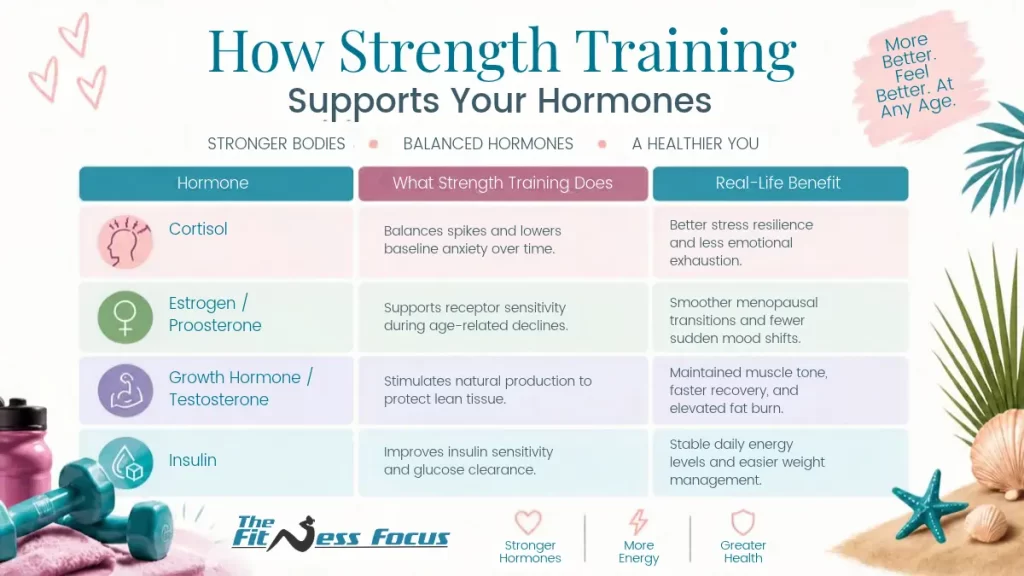
How Strength Training Optimizes Your Hormone Baseline
| Hormone | What Strength Training Does | Real-Life Benefit |
| Cortisol (Stress) | Balances spikes and lowers baseline anxiety over time. | Better stress resilience and less emotional exhaustion. |
| Estrogen / Progesterone | Supports receptor sensitivity during age-related declines. | Smoother menopausal transitions and fewer sudden mood shifts. |
| Growth Hormone / Testosterone | Stimulates natural production to protect lean tissue. | Maintained muscle tone, faster recovery, and elevated fat burn. |
| Insulin | Improves insulin sensitivity and glucose clearance. | Stable daily energy levels and easier weight management. |
How to Build a Hormone-Supportive Workout Routine
Now that you understand how useful strength training can be during this season of life, let’s look a little bit more about how to actually build a hormone-supportive workout routine to help you reach your goals. Remember consistency is key if you want to really feel the difference.
Frequency: How Often to Train?
To strength train for optimal hormone health and overall health, it’s best to aim for two to three full body strength training sessions each week. You can easily do this at home with resistance bands or a set of dumbbells or adjustable dumbbells.
What Does a Hormone-Supportive Strength Workout Actually Look Like?
Forget high-intensity circuits that leave you feeling overly sore or tired. A hormone-supportive strength training workout focuses on controlled, compound movements that recruit large muscle groups, stimulate bone density, and keep your cortisol levels stable.
Can you strength train at home?
Of course you can! You don’t need a gym membership or an array of heavy machines to get results. A single pair of adjustable dumbbells or a set of looped resistance bands are all you need to complete a highly effective, hormone-supportive workout in your living room.
Wondering what exercises to do?
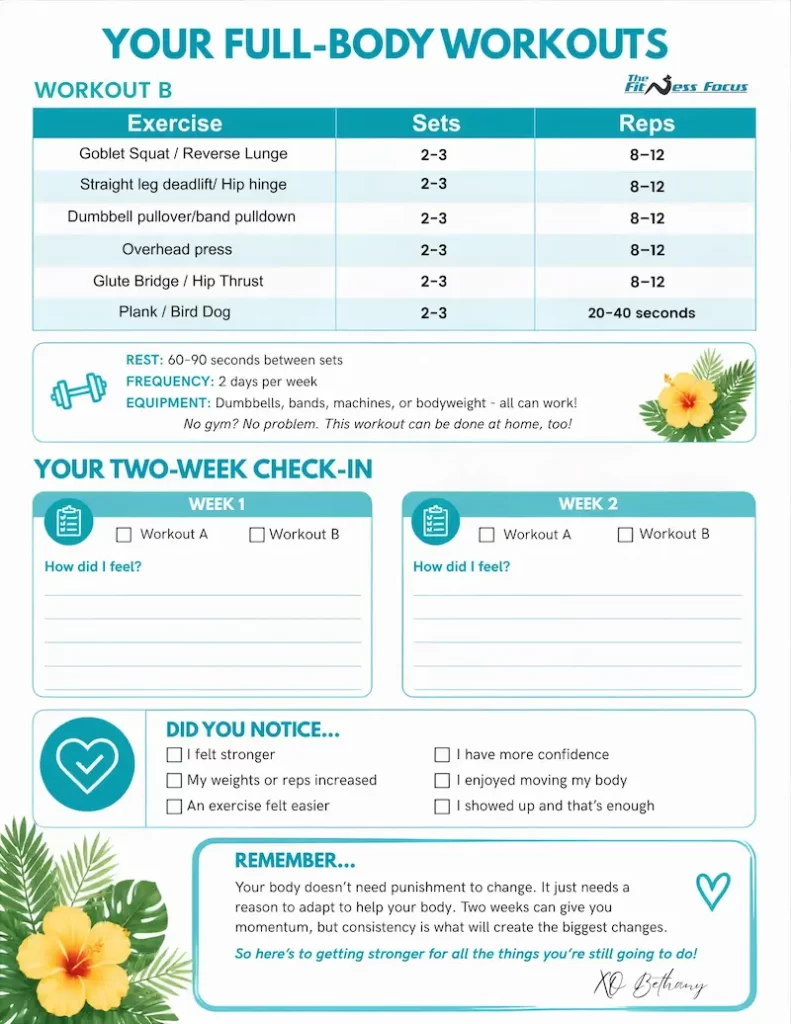
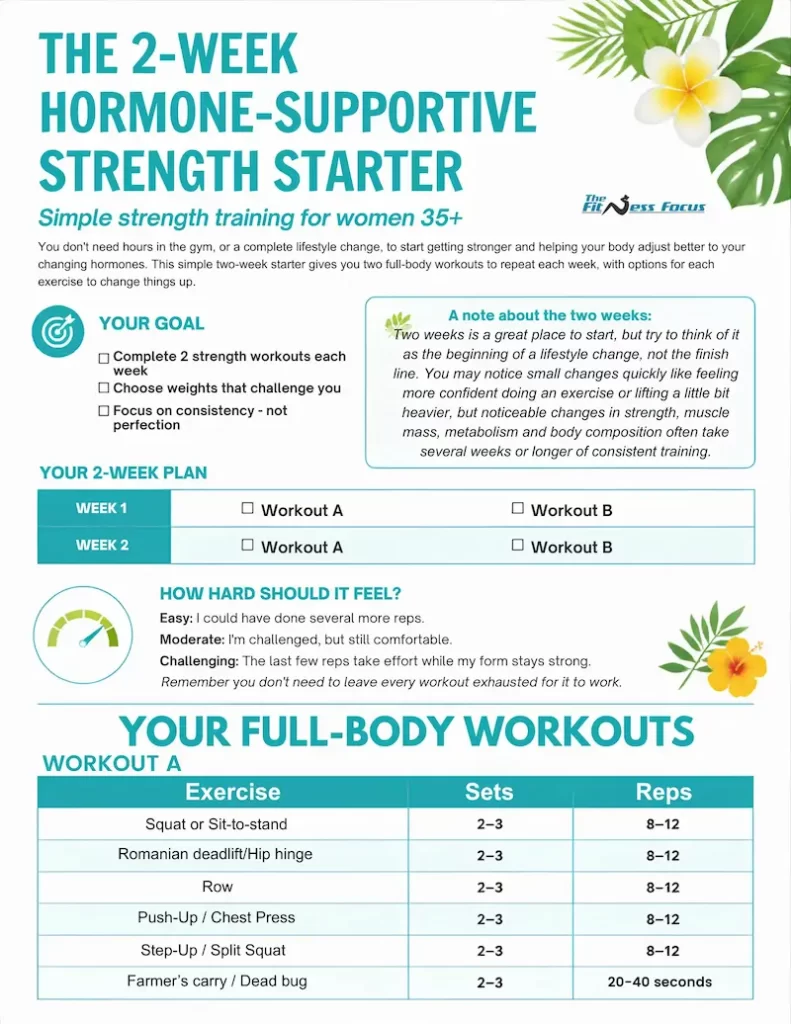
👉 Free Download Click here to download the free, step-by-step 2-week Hormone-Supportive Strength Starter designed specifically for women over 35.
Get the exact exercises, sets, and reps you need to lift weights safely, protect your metabolism, and build real-world resilience.
Common Strength Training Mistakes Women Over 35 Make
While lifting weights is imperative for your health and well-being, making these common mistakes can delay your progress, spike stress hormones, and even lead to injury. Avoiding these eight frequent pitfalls will help you make the most of your routine:
1. Choosing workouts based solely on calories burned. Strength training isn’t meant to compete with cardio when it comes to burning calories, because its magic happens after the workout. Building lean muscle upgrades your metabolism, allowing your body to naturally burn more energy (calories) at rest.
2. Lifting weights that are too light for too long. I see this far too often. But to stimulate bone density and preserve muscle, you always have to challenge your body. If you can breeze through 20 repetitions of an exercise without breaking a sweat or feeling like you could do even more, it’s time to increase the weight. It will help you build strength, get a more defined body, and feel better than ever…you will not get bulky!
3. Switching up your workouts too often instead of progressive training. Jumping from one random internet workout to another or changing your routine every single week, will leave your muscles guessing without ever building any real strength. What your body actually needs to make progress is repeated exposure to the same structured movements over an 8-12 week cycle to adapt, grow, and progress. So instead of constantly changing your exercises, keep a routine you like and focus on changing your resistance levels by lifting heavier weights whenever you can.
4. Training too hard without prioritizing your recovery. It stinks, but as we get older, our bodies take longer to bounce back from intense strain. Ugh it’s one of my least favorite parts of getting older. Even a bruise, cold, or cut takes longer to heal or get over than it used to.
If a workout leaves you depleted for days, try lowering the intensity so you finish your sessions feeling challenged and energized – not defeated in every way.
5. Not eating enough protein each day. This is the single biggest dietary mistake most women over 35 make when trying to lose weight. Adequate protein provides the necessary building blocks your muscles need to repair themselves and grow, while also supporting your immune and hormonal systems.
Find out more about why your body needs protein after 35 here.
6. Only training the muscles you want to change the most. While it’s natural to want to focus your training on target problem areas like your stomach, upper arms, butt or legs, prioritizing only isolated muscle groups creates structural imbalances that can lead to injury. And in general, just isn’t going to work.
A truly age-defying routine has to be well-rounded and include all body part areas like your upper body, lower body, back and core to protect your posture and long-term mobility.
7. Using muscle soreness as your primary scorecard. How sore you are after a workout does not mean the workout was more effective. It just means you’re lengthening your recovery time and putting unnecessary stress on your joints – all things you don’t want to be doing to yourself as you get older.
While it’s normal and completely okay to feel really sore after a workout when you’re first starting out, the more regularly you lift weights, the less terribly sore you’ll feel as time goes on.
Here are a few additional FAQ’s about strength training for hormone health
Can strength training help with belly fat after 40?
It can. But remember you can’t “spot-reduce” fat. The changes that happen during perimenopause and menopause can cause the body to store visceral fat around the abdomen. Yippee, right? The good news is strength training alters this fat storage by helping to improve your insulin sensitivity and lowering cortisol levels, which help your body naturally redistribute fat and burn fat more effectively. And also, building muscle helps your body burn more calories at rest.
Can lifting weights help with insulin resistance?
Yes. Muscle tissue is your body’s primary way of removing glucose from your bloodstream. So when you lift weights, your muscles absorb sugar out of your blood without needing insulin to help. This makes strength training one of the most powerful non-medical tools available for reversing insulin resistance and stabilizing daily energy.
Is strength training better than cardio for women over 40?
Neither is better than the other, because both types of exercises offer completely different benefits as you get older. Cardio is excellent for training your heart, lungs, and endurance. Strength training is what protects your bone density, prevents age-related muscle loss, and improves your resting metabolism. A truly well-rounded workout routine combines both with a recovery day and mobility work. Try prioritizing strength training 2-3 times a week while using cardio for cardiovascular health (4 days/week) and active recovery/mobility to stay mobile.
How heavy should women over 40 lift?
This really depends on your current fitness level and experience. But basically, you should lift a weight that feels challenging when doing 8 to 15 reps. If you can easily complete 20 reps without your muscles feeling tired, the weight you’re using is too light to have any affect on your bone density or muscle growth. The ideal weight should make the last 2 or 3 repetitions of a set feel somewhat challenging to finish while still maintaining proper form. If your form is breaking down, stop and lower the weights. We always want to lift safely.
Can you build muscle during perimenopause?
Of course you can! Your body just has to work a bit harder to do it due to declining estrogen levels (estrogen helps with muscle repair, so the process can take a little longer.) While building muscle during perimenopause may take slightly longer than it did in your twenties, it is entirely possible to get fit if you back up your workouts with a healthy, high-protein diet as well as getting proper sleep and regulating stress properly.
What is the best time of day to strength train for hormone health?
The best time of day to strength train is simply the time that works best for you to stay consistent over time. Biologically, lifting in the late afternoon offers a slight advantage because muscle strength peaks and cortisol levels are naturally lower at that time.
However, if afternoon sessions don’t fit into your schedule like most people who work a regular job, any other time of day that works is perfectly fine. The only thing to watch out for is working out too late to ensure you’re not hurting your sleep to make your workout happen. Because now you know that not getting enough sleep will quickly raise your stress hormones levels and lead to side effects you’re trying to avoid.
Your Next Steps to Feeling Your Best
Being over 35 isn’t the time to slow down, relax, and just accept physical decline. If you don’t move it, you will literally lose it. So there is no better time than now to get your booty off the couch and start building a stronger, more resilient foundation than ever before. By shifting your focus from doing only intense cardio workouts to including purposeful strength training, you can start taking direct control of your hormones, your metabolism, and your daily energy.
Stop waiting for the perfect moment to start and just get started! Because you really don’t have to be great to start weightlifting, you just have to start weightlifting to get the results you want. Pick up a set of weights this week, protect your physical freedom, and choose to live your absolute best life on your own terms.
Did this post inspire you to start lifting? Leave a comment below telling me if you plan to train at home or at the gym – and don’t forget to grab your free strength training plan above.